About

The Sisters of Providence were formed by Blessed Antonio Rosmini-Serbati, a native of the County of Tyrol, and the Abbé Jean-Baptiste Löwenbruck, a native of the region of Lorraine in France. Rosmini, who was ordained a Catholic priest in 1821, dedicated his life to submitting to Divine Providence in undertaking any work he was presented with. As part of this, he thought to form a religious community of men dedicated to this vision, called the Institute of Charity. He met Löwenbruck in June 1827, and was impressed by his desire to form a community of priests to evangelize the isolated communities of the mountains of that region. They set up a house in Domodossola, which they called Calvario (Calvary), from which Löwenbruck would travel through the Ossola valleys, preaching and teaching the people of the towns there.
Löwenbruck found, from his time among the people of that valley, that there was a strong desire among many of its young women to offer themselves completely to the service of God. What they lacked was any means of education.
In order to channel and direct this desire, he conceived of a plan to establish a religious institute to give them an outlet for their calling. He initially contacted some established religious institutes in that region. None would offer assistance in this project, however. Then he remembered that in his homeland of Lorraine he had known a flourishing group of Religious Sisters, called the Congregation of Divine Providence, founded by the Abbé Jean-Martin Moye in 1762, who were dedicated to the poor, especially through the education of their children. Wishing to find a place for all these young women as soon as possible, Loewenbruck turned to these French Sisters.
In 1830 Löwenbruck began corresponding with the Superior General of the congregation, the Abbé E. Feys, the pastor of the town of Portieux, where their motherhouse was located, requesting that some members of that congregation go to the Tyrol to initiate the work he envisioned. Feys initially demurred, suggesting that Löwenbruck set up his own structure locally. This, however, was beyond his authority and which went against his tendency to act out of obedience rather than initiating a work.
In November 1831, though, perhaps fearing another suppression of religious communities in France, Feys wrote to Löwenbruck to suggest that he send some Piedmontese girls to France to begin formation in the consecrated life from the established congregation. Löwenbruck responded enthusiastically, organizing a group of four girls to head to Portieux, who set out on 26 November. The journey lasted more than two weeks, as the women had to cross the Simplon Pass in the dead of winter, often walking barefoot for miles. Nevertheless, they arrived at the motherhouse and began training as postulants for the proposed community. After several months, Feys sent Löwenbruck glowing appraisals of these candidates.
During 1832, while the Italian women were undergoing their formation in France, Löwenbruck set about securing a home for the new institute. In the course of the preaching tour, a local priest in Locarno, in Canton Ticino, suggested to him the availability of an abandoned hospital there, known as San Carlo, which he recommended that the local authorities transfer to him. Despite its wretched conditions, having no doors or windows, Löwensbruck accepted it and recruited another four women to start community life there.
The four women arrived in Locarno in March 1832 by ferry in the middle of a driving rain, but soon set up a routine of life similar to that of the Brothers of Charity, arising at 4:30 A.M. for prayers, followed by long days of work preparing the house to form their own novitiate, and of study in the rudiments of their faith, given to them by a local priest. They survived on donations collected by Löwenbruck in the course of his preaching tours. These were never sufficient to provide an adequate living, however, and they suffered from hunger and cold for months. On that 3 July 13 new candidates joined them, soon followed by the four women returning from France. They were accompanied by two French Sisters.
The Sisters then joined the community already organized at Locarno in Ticino, designed to be a novitiate as well as a school for the poor. The novitiate was formally opened on 31 July. Löwenbruck provided no funds, however, and though they opened a school, but being only minimally educated they could get no salaries from the government as recognized teachers. Further complications included the isolation of the French Sisters, one of whom was still unable to speak Italian, and their consequent difficulty in preparing their Italian charges. Added to this was Löwenbruck's incompetence as a Director of the Sisters, making one mistake after another, ignoring the advice of Rosmini. His mishandling of various matters even came to the attention of the local bishop. Rosmini tried to lead his disciple gently in taking these problems in hand, sending various priests to support him. Finally the French Sister Superior wrote to Rosmini to take action over the confusion of the house. By December 1832, even Löwenbruck acknowledged his inabilities and begged the founder of his own institute to assume responsibility.
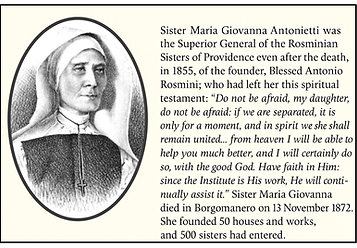
This bad management finally induced Rosmini to intervene. He adapted the Rule written by a foundress with whom he worked, Sr. Maddalena di Canossa, to suit it to its new conditions, and thenceforward together with the assistance of Sr. Giovanna Antonietti, who became the first Superior General, assumed entire responsibility for the Sisters of Providence. He secured training programs for all the Sisters involved in education, so that, by the end of 1833, all teaching Sisters of the Institute were recognized by the local government. Thus they became a distinct but integral part of the Institute of Charity, the "Rosminiane", as the Italians soon began to call them.
Antonio Rosmini was born in Rovereto on the 24th March 1797. At that time Rovereto was in the Italian Tyrol (today it is in the Trentino Region, Northern Italy), and although it formed part of the Austrian Empire, it was Italian in tradition, literature and learning. Antonio was an unusual child, he spent long periods in the church and he constantly tried to integrate his studies with his life of prayer. To him the greatest event of his life was to be raised by Baptism to supernatural life. He was an avid reader with a love of poetry and had a huge appetite for learning and went on to study hypnotism, telepathy, psychology and pedagogy and he developed a life-long interest in mathematics and education. He even studied German, so that he could understand the new education theories which were in favour at that time.
His belief is that the supreme aim of education activity is to form the heart. (Intellectual Charity).
Our education, values, and culture stem from the philosophy of Blessed Antonio Rosmini who was concerned with the education of the whole person: “a pupil must be allowed to grow and develop as an integrated human person”, emphasizing the importance of holistic education. He believed that the human person is made up of feeling, intelligence, instinct and will and as the young child/ student engages in different activities, these contribute to the overall development of the human person. Rosmini’s teachings inspire our teachers and educators to provide a supportive and enriching environment, with an emphasis on truth, justice and goodness. Our mission is centered on providing a balanced approach, nurturing the intellectual, physical and moral development. Our schools emphasize academic achievement, together with the development of Gospel values of kindness and compassion, leading to a well-rounded education which prepares young people for their role in society. Throughout his life he continued to see in all the things the directing hand of Providence and this vision was the basis of all his asceticism, clearly stated in his Maxims of Christian Perfection (1830). They summarise the principles on which he based his life and allowed him to remain serene in the face of many frustrations.
The translation of the Maxims by Dewhirst (1997), are as follows:
-
To desire only and without limit to please God, that is, to be just. The first priority of the Christian life is to develop our relationship with God, to pray constantly and to reflect whether our lives and actions mirror the love of God.
-
To direct all one’s thoughts and actions to the increase and glory of the Church of Jesus Christ. God delights in his Son Jesus and Jesus delights in all those who follow him as member of his Church. Therefore the Christian desires to serve the Church of Jesus Christ. This is the means whereby God’s kingdom will come to be on earth.
-
To remain perfectly at peace with regard to all that happens in accordance with God’s designs, with regard to ourselves or to the Church of Jesus Christ. Since all happenings in the world are in the hands of God we should seek to remain tranquil however events turn out. Worrying and planning for the future are not part of the Christian calling. What is required is simply to follow God’s will.
-
To abandon oneself entirely to divine providence. We should trust the God who loves and cares for us. The consequences of this principle involve simplicity of life, being content with our lot but also willing to change when God prompts us. God is present in all our joys and sorrows and in every twist and turn of our daily journey.
-
To acknowledge profoundly one’s own nothingness. Sometimes pride in our activities can stand in the way of God’s love. The ideal life is one which is retiring, silent but diligent.
-
To direct all the actions of one’s life with a spirit of understanding. The reflective Christian is guided in all things by the spirit of wisdom. Christians who live by the light of the Holy Spirit seek to amend their own lives first, to be good at the job that God has given them, to be conscious of the needs of others and even to be drawn into a hectic apostolate if this is God’s will. Peace of mind and heart will be indicators that one is on the right track.
Our Mission
To respond generously to the needs of society with love, humility, and dedication.

Our spirituality is defined by a passionate, yet humble, desire to do God's will and serve wherever there is a need, embracing a life of "love without limits".